How can Portland employers use shuttle programs to meet Oregon commute-reduction goals?
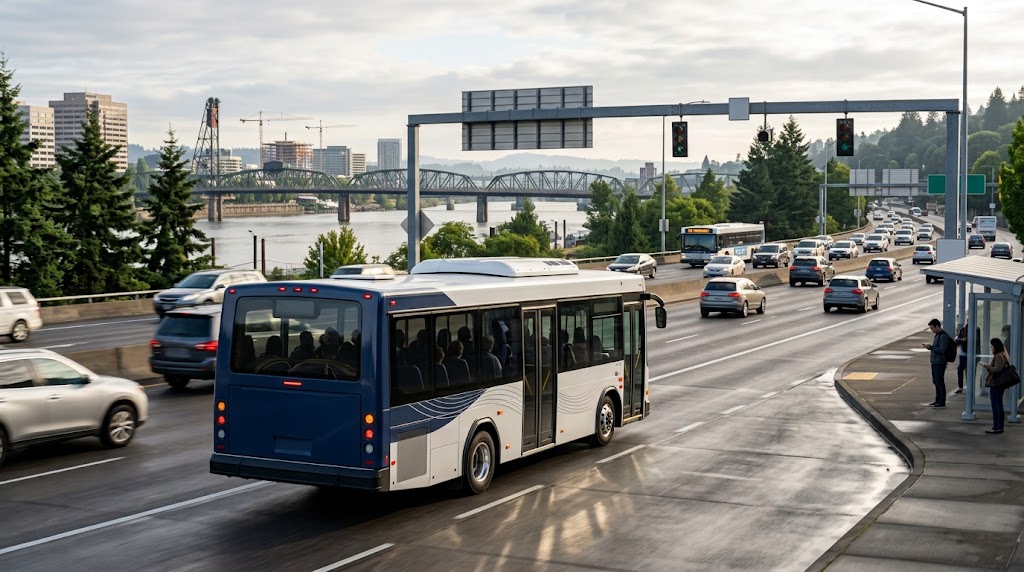
Portland employers can use an employee shuttle service to meet Oregon's commute-reduction goals by replacing drive-alone trips with shared rides, most often between the worksite and a MAX station, a park-and-ride lot, or the neighborhoods where employees live. Under the Oregon Department of Environmental Quality's Employee Commute Options (ECO) rules, larger Portland-area employers must offer commute options with the potential to cut employee auto trips by 10%, and a well-planned shuttle is one of the most visible ways to do it.
American Town Car has provided Sprinter vans, mini buses, and recurring scheduled service to Portland businesses since 2008. This guide explains what ECO requires, which shuttle models work, how to design and measure a program, and where a chauffeured provider fits.
What do Oregon's Employee Commute Options rules require?
Oregon's ECO rules require employers in the Portland metro area with more than 100 employees at a single worksite to offer commute options that could reduce employee auto trips to that site by 10% from a baseline. The rules are part of the state's federally required plan to keep ozone pollution in check, and they have applied in the Portland area since 1996.
Covered employers must:
-
Survey employees to establish a baseline auto trip rate, the number of commute vehicles arriving at the worksite divided by the number of employees who report there.
-
Reach at least a 75% survey response rate. DEQ counts any shortfall as drive-alone trips.
-
Submit a trip reduction plan with commute options that have the potential to cut auto trips by 10% within three years of the baseline survey.
-
Survey again every two years to measure progress.
DEQ won't fine an employer simply for missing the 10% target if it shows good faith by surveying employees and carrying out a reasonable plan. DEQ has also proposed changes to the program in recent years, so check its ECO page for the current rules before you finalize a plan.
How does an employee shuttle service reduce drive-alone trips?
An employee shuttle service reduces drive-alone trips by solving the specific problem that keeps people in their cars: the gap between where transit stops and where they need to be. Portland has strong transit corridors, but many worksites sit a long walk from a MAX station, and many shifts start before or end after transit runs frequently.
A shuttle closes that gap in three ways:
-
It shortens the first or last mile between a transit stop and the front door.
-
It runs on the employer's schedule, matched to shift changes rather than a transit timetable.
-
It gives employees a dependable ride, which makes them more willing to leave the car at home.
Shuttles also work alongside the other options DEQ lists as typical incentives, such as transit and vanpool subsidies, carpool matching, and telecommuting.
Which shuttle program models work for Portland employers?
Four shuttle models cover most Portland worksites, and the right one depends on where employees live and when they work.
|
Shuttle mode |
How it cuts drive-alone trips |
Best for |
|
Transit connector |
Links the worksite to the nearest MAX station or transit center |
Sites more than a short walk from transit |
|
Park-and-ride |
Moves employees from a remote lot to the worksite |
Campuses with limited parking |
|
Shift shuttle |
Runs at shift changes when transit is less frequent |
Hospitals, manufacturing, and 24-hour operations |
|
Express route |
Picks up in neighborhoods where many employees live |
Employers with clusters of staff in one area |
Most programs start with one model, measure ridership, and add routes once the first one proves itself. Vehicle size follows demand: a Mercedes Sprinter carries up to 14 riders per run, and mini buses carry 27 or 37. You can compare capacities in our full luxury fleet.
How do you design an employee shuttle program?
Design the shuttle around your own ECO survey data, because it already shows how employees commute and where the drive-alone trips come from.
-
Review your ECO survey results to find employees who drive alone but live near transit or in clusters.
-
Choose the shuttle model that fits those employees: transit connector, park-and-ride, shift shuttle, or express route.
-
Set the schedule around shift start and end times, and around MAX arrivals if you're connecting to transit.
-
Size vehicles to the busiest run, then add capacity only when ridership calls for it.
-
Run a pilot for at least three months so employees have time to change their habits.
-
Promote the service at onboarding, in internal channels, and alongside other commute incentives.
-
Count riders on every run so you can show results in your next survey cycle.
Recurring service makes this practical. A scheduled shuttle can be set up once and repeated every workday, and blocks of hourly service suit shift changes where one vehicle runs several loops.
How do you measure a shuttle program's results?
Measure a shuttle program the same way DEQ measures your progress: by the auto trip rate in your follow-up ECO survey. Every employee who switches from driving alone to the shuttle lowers the number of commute vehicles arriving at the worksite.
-
Track ridership: count riders on every run each week, so you can see which routes and times work.
-
Survey well: push for a response rate above 75%, because DEQ counts missing responses as drive-alone trips, which can hide the shuttle's impact.
-
Compare cycles: set each follow-up survey's auto trip rate against your baseline to see how much the shuttle moved it.
-
Document the effort: record the shuttle in your trip reduction plan, since DEQ looks for good faith implementation.
DEQ's ECO survey guidance explains how shared rides are counted, so review it when you add the shuttle to your plan.
Where does American Town Car fit in an employee shuttle program?
American Town Car fits best for pilot shuttles, small and mid-sized routes, and the peak days around a commute program, using chauffeured Sprinter vans and mini buses on a recurring schedule. Very large, all-day commuter networks are often run by dedicated shuttle operators, and many employers use a chauffeured provider alongside them.
-
Vehicles: Mercedes Sprinter vans for up to 14 riders and mini buses for 27 or 37.
-
Scheduling: recurring service for daily runs, plus 24/7 availability by reservation for early and late shifts.
-
Safety: $5 million in liability coverage on every ride, with chauffeurs who pass background checks and hands-on training.
-
One account: shuttle runs, executive travel, and event transportation can all sit under the same company account.
Learn how shuttle runs connect with your other business travel through our corporate transportation service.
Frequently asked questions
Does the ECO program apply to my company?
It applies if you have more than 100 employees reporting to a single worksite within the Portland Air Quality Maintenance Area.
Will DEQ fine us for missing the 10% goal?
No, not for missing the goal alone. DEQ looks for good faith: surveying employees, submitting a reasonable trip reduction plan, and carrying it out.
How often do we need to survey employees?
After the baseline survey, covered employers survey again every two years, with a response rate of at least 75%.
What size vehicle does a shuttle program need?
Size it to your busiest run. A Sprinter van carries up to 14 riders, and mini buses carry 27 or 37, so many programs start with one van and grow from there.
Can a shuttle run before and after regular transit hours?
Yes. American Town Car operates 24/7 with advance reservations, so shuttles can match early and late shift changes.
Start your employee shuttle program
Share your worksite, shift times, and expected ridership, and American Town Car will suggest vehicles and a schedule for a pilot. Call (503) 530-9199 or request a corporate transportation quote.